
October 2026 Financial Newsletter: Scam Alerts, Tax-Free Income, Wills & Your 401(k)

Ghost Tapping Scams Are on the Rise: What You Need to Know
As more people use tap-to-pay technology for everyday purchases, scammers have found a new way to exploit that technology in the form of ghost tapping. And while ghost tapping sounds like something out of a scary movie, it's a scam that can have very real consequences.
Tap-to-pay technology is designed to make payments quick and convenient. Whether you use a contactless bank or credit card or a smartphone wallet, the systems rely on near-field communication, or NFC, to send payment information when placed near a card reader. It's typically a faster, more secure way of paying that is protected by layers of encryption.
Unfortunately, criminals are always looking for new ways to take advantage of consumers and have begun to use contactless payment technology to steal money and personal data. In a ghost tapping scam, fraudsters use hidden card payment readers, fake terminals, or compromised devices to trigger an unauthorized contactless transaction. In some cases, they may try to get close enough to a person's wallet, pocket, or handbag to read a contactless card. In others, they use social engineering to trick someone into tapping their phone or card against a fake or altered payment terminal. Some scams may also involve stolen card details being loaded onto a fraudster's digital wallet and then used to make contactless purchases.
While the idea of someone stealing your money with a quick tap sounds frightening, most major banks and card providers have security systems that monitor unusual account activity, and many contactless transactions are limited in value. In addition, mobile wallets typically require facial recognition or a passcode before payment is approved. Still, there are steps consumers can take to help reduce the risk of falling victim to a ghost tapping scam, such as:
- Keep your cards and phone secure, especially in crowded places, such as airports, shopping centers, and public transportation.
- Be cautious if someone carrying a device gets unusually close to you for no obvious reason.
- See if your bank offers card controls through its online app and consider using contactless features only when necessary.
- Check your account regularly for fraudulent activity and set up fraud alerts with your bank or credit card provider so you are notified of any suspicious card activity.
- Consider using a wallet with RFID-blocking technology.
If you are targeted by a ghost tapping scam, contact your bank or credit card provider immediately and request that they freeze/cancel your card. You should also update any passwords that are linked to your banking and digital wallet accounts.
This content has been reviewed by FINRA.
Prepared by Broadridge Advisor Solutions. © 2026 Broadridge Financial Services, Inc.
Generating Tax-Free Income
What is generating tax-free income?
Although income is usually taxable, there are a number of vehicles that can produce tax-free income. Examples of tax-free income can include:
- Roth IRA distributions
- Coverdell education savings account and 529 plan distributions
- Tax-exempt bond interest
- Interest on Series EE savings bonds used for education
- Life insurance (death benefit)
- Loans against and certain withdrawals from cash value insurance
- Certain gains from the sale of qualified small-business stock
- In certain situations, gain on sale of personal residence
How can IRAs be used to generate tax-free income?
Unlike contributions to a traditional individual retirement account (IRA), contributions to a Roth IRA are never tax deductible. Since you are taxed on your IRA contributions currently, that money will be returned to you tax free when withdrawn in the future. In addition, the earnings (interest) on Roth IRAs grow federal income tax deferred and are tax free when withdrawn (assuming your distribution is a "qualified" one--a distribution is qualified if you satisfy a five-year holding period and your distribution is made either after you've reached age 59½ or after you've become disabled). Because of these features, the Roth IRA is a useful tool for generating tax-free income.
Tip: Employers can allow employees to designate their contributions to a 401(k) or 403(b) plan as after-tax Roth contributions. Under certain conditions, these contribution amounts and related earnings will be tax free when distributed.
529 plans and Coverdell education savings accounts
529 plans (which include both 529 college savings plans and 529 prepaid tuition plans) allow individuals to save for college on a tax-advantaged basis. Any earnings on funds contributed to a 529 plan grow federal income tax deferred. Withdrawals are not subject to federal income tax if they are used to pay qualified higher education expenses. If used appropriately to save and pay for college expenses, then, a 529 plan can generate tax-free income.
The Coverdell ESA is another vehicle that allows individuals to save for a child's higher education on a tax-favored basis. Like a 529 plan, your contributions to a Coverdell ESA are not tax deductible. However, the earnings (interest) in the Coverdell ESA grow federal income tax deferred. Any money you withdraw from the Coverdell ESA will be tax free if used for qualified education expenses (including elementary and secondary school expenses). A Coverdell ESA, therefore, will generate tax-free income (if used properly).
Caution: Investors should consider the investment objectives, risks, charges, and expenses associated with 529 plans carefully before investing. More information about 529 plans is available in the issuer's official statement, which should be read carefully before investing. Also, before investing, consider whether your state offers a 529 plan that provides residents with favorable state tax benefits. The availability of the tax or other benefits mentioned above may be conditioned on meeting certain requirements. All investing involves risk, including the possible loss of principal, and there can be no assurance that any investment strategy will be successful.
How can bonds be used to generate tax-free income?
Tax-exempt bonds and Series EE savings bonds used for education are the two types of bonds that can be used to generate tax-free income.
Tax-exempt bonds
Interest on certain obligations of a state, territory, U.S. possession, or political subdivision can be excluded from your federal gross income. In addition, if you earn interest on tax-exempt bonds issued in your home state, generally, the interest will not be subject to state or local tax. Municipal bonds, therefore, can help generate tax-free income for you.
Caution: For investors who are subject to the alternative minimum tax (AMT), however, interest income from certain municipal securities must be included in income when calculating the tax. If purchased as part of a tax-exempt municipal money market or bond mutual fund, any capital gains earned by the fund are subject to tax, just as any capital gains from selling an individual bond are. Note also that tax-exempt interest is included in determining if a portion of any Social Security retirement benefit received is taxable.
Series EE savings bonds
The interest received on Series EE savings bonds is exempt from state and local income taxes. In addition, the interest on Series EE bonds purchased on or after January 1, 1990, may be exempt from federal income taxation if the bonds are used for certain educational purposes and if certain requirements (including adjusted gross income limitations) are met. Therefore, assuming you meet the requisite conditions, Series EE savings bonds can generate tax-free income.
How can life insurance be used to generate tax-free income?
Permanent life insurance can be used to generate tax-free income in two ways. The purchase of insurance should be considered because of its death benefit proceeds and its cash value buildup.
Death benefit
Generally, amounts you receive under a life insurance contract paid by reason of the death of the insured are not included in your gross income; the proceeds are tax free. Amounts payable on the death of the insured are excluded, whether these amounts represent the return of premiums paid, the increased value of the policy due to investments, or the death benefit feature. It is immaterial whether the life insurance proceeds are received in a single sum or otherwise. (However, any interest paid along with the life insurance proceeds is usually taxable.)
Cash value insurance transactions
The cash value in a universal life insurance policy can also be a useful tool for generating tax-free income. In general, amounts received under a life insurance contract (other than an annuity) are treated first as a recovery of basis; only after the entire basis has been recovered is there taxable income. Therefore, any withdrawal you make from your cash value life insurance policy (up to the amount of your basis or investment in the contract) can be taken tax free.
It is also possible for you to obtain a loan from your insurance company in an amount up to the cash value of the policy. For the most part, loans are not treated as taxable distributions (although interest will be charged by the insurer).
Caution: The above rules do not apply to modified endowment contracts (MECs).
Caution: Policy loans and withdrawals will reduce the policy's cash value and death benefit.
How can qualified small-business stock be used to generate tax-free income?
Qualified small-business stock is stock that meets requirements set forth in Internal Revenue Code Section 1202. Essentially, this is stock issued by domestic C corporations engaged in certain "active businesses" whose assets do not exceed $50 million (or $75 million for stock issued after July 4, 2025). The stock must be issued after August 10, 1993, and must be acquired when originally issued by the corporation.
Noncorporate taxpayers may exclude 50 percent of any capital gain from the sale or exchange of qualified small-business stock issued after August 10, 1993, and held for the required holding period. For qualifying stock acquired after February 17, 2009 and before September 28, 2010, the percentage that may be excluded is 75 percent. For qualified stock acquired after September 27, 2010 and before July 5, 2025, the percentage that may be excluded is 100 percent. For stock issued on or before July 4, 2025, the required holding period is more than five years.
For stock issued after July 4, 2025, a tiered holding period applies, allowing a 50 percent exclusion after at least three years, a 75 percent exclusion after at least four years, and a 100 percent exclusion after five years or more. The amount of gain eligible for the applicable exclusion in a tax year is limited to the greater of:
- Ten times the taxpayer's (aggregate) adjusted basis in the stock that is sold, or
- $10 million ($5 million if married filing separately) of gain from stock in that corporation ($15 million, or $7.5 million if married filing separately, for stock issued after July 4, 2025, with the $15 million cap adjusted annually for inflation beginning after 2026), reduced by the amount of eligible gain you used to figure your exclusion in earlier years.
Caution: Because of the new rules for stock issued after July 4, 2025, you can now sell stock after just 3 or 4 years. If you do that, you only get a 50% or 75% exclusion. The remaining taxable portion (the other 50% or 25%) will be taxed at that specialized 28% capital gains rate instead of the standard federal capital gains rates.
How can the gain on sale of your personal residence generate tax-free income?
If you sell your principal residence at a gain, you may be able to exclude from taxation all or part of the capital gain. If you meet the requirements, you can exclude up to $250,000 (up to $500,000 for married couples filing jointly) of the gain, regardless of your age.
You can generally exclude the gain only if you owned and used the home as your principal residence for at least two out of the five years preceding the sale (the two years do not have to be consecutive). An individual, or either spouse in a married couple, can generally use this exemption only once every two years.
Even if you fail to meet these two tests, though, you may be eligible to claim a partial exemption.
Prepared by Broadridge Advisor Solutions. © 2026 Broadridge Financial Services, Inc.
Do You Need a Will?
Only about one-third of U.S. adults say they have a will. While it's to be expected that older people would be more likely to have one, it may be surprising that fewer than half of people in their 50s and 60s have taken the time to create this essential estate-planning document.
Percentage of U.S. adults who have created a will, by age group:
- Ages 18–39: 15%
- Ages 40–49: 20%
- Ages 50–59: 32%
- Ages 60–69: 46%
- Ages 70–79: 66%
- Ages 80+: 81%
Source: Pew Research Center, November 6, 2025
This content has been reviewed by FINRA.
Prepared by Broadridge Advisor Solutions. © 2026 Broadridge Financial Services, Inc.
What's in Your 401(k)?
Almost 70 million Americans contribute to a 401(k) plan, and millions more contribute to similar workplace plans, such as a 403(b), 457(b), or federal Thrift Saving Plan. Together, these plans held an estimated $14.2 trillion in assets at the end of 2025.(1)
Contributing to a 401(k) can be a big step toward a more comfortable retirement. But it's important to understand what you are getting for your money.
Filling the envelope
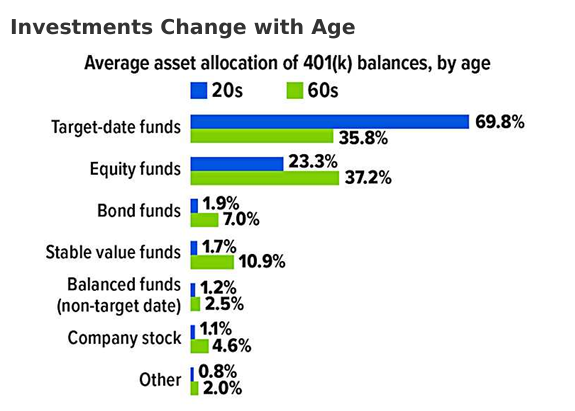
A 401(k) is not an investment in itself. It is more like an envelope that holds investments under tax-advantaged rules. These plans usually offer a variety of funds as investment options, typically including domestic stock funds, international stock funds, domestic bond funds, and target-date funds — the most common investment, held by seven out of 10 401(k) participants.(2)
A simple approach
Target-date funds are often the default option in workplace plans, so you may have one without fully understanding what it is. These are "all-in-one" funds intended to be your only investment. They generally hold a mix of other funds containing stocks, bonds, and cash alternatives, selected for a time horizon — the target date — when an investor expects to retire or need access to the money. As the target date approaches, the fund typically shifts toward a more conservative asset allocation to help preserve the value it may have accumulated and potentially provide income.
These funds offer a simple approach to investing, but the allocation is based solely on the target date and does not take into account the investor's risk tolerance, personal goals, asset levels, sources of income, or any other factors that make an investor unique.
The principal value of a target-date fund is not guaranteed before, on, or after the target date. The return and principal value of these funds fluctuates with changes in market conditions. Shares, when sold, may be worth more or less than their original cost.
Choosing your own investments
The average 401(k) offers almost 30 different funds, so there are usually plenty of options for an investor who wants to take a more customized approach and spread investments among a variety of funds.(3) With this approach, you can create your own asset allocation and diversification strategy by directing your contributions to the funds you choose in the percentages you choose.
If you take this approach, it's important to understand the goals and underlying holdings of any fund you choose. You may want to check your portfolio's allocation periodically to see if it remains close to your targeted allocation. If you want to adjust your allocation, you could rebalance by buying and selling shares as appropriate and/or by changing the percentages of future contributions. Rebalancing in a 401(k) typically does not create tax consequences.
Company stock
Some 401(k) plans also offer company stock as an investment option. This could be worth considering if you believe in your company's future prospects. But it's important to keep any company stock investments in perspective. Becoming overinvested in a single stock, whether it's your company or not, can throw off your strategy and expose you to additional risk.
Whatever investments you choose, know what you are buying and why these investments are appropriate for your situation. If you invest outside of the workplace, it's also important that your 401(k) investments be balanced with your other investments.
Asset allocation and diversification do not guarantee a profit or protect against investment loss. All investing involves risk, including the possible loss of principal, and there is no guarantee that any investment strategy will be successful. Investing internationally carries additional risks such as differences in financial reporting, currency exchange risk, as well as economic and political risk unique to the specific country. This may result in greater share price volatility. Bond funds are subject to the same inflation, interest rate, and credit risks associated with their underlying bonds. As interest rates rise, bond prices typically fall, which can adversely affect a bond fund's performance.
Funds are sold by prospectus. Please consider the investment objectives, risks, charges, and expenses carefully before investing. The prospectus, which contains this and other information about the investment company, can be obtained from your financial professional.
(1–3) Investment Company Institute, 2026
This content has been reviewed by FINRA.
Prepared by Broadridge Advisor Solutions. © 2026 Broadridge Financial Services, Inc.